
Equine Services
Our friendly practice offers the following equine services to horse owners…
Gastroscopy
How we diagnose gastric disease in horses
A change in behaviour is often the first indication that your horse could be affected by gastric disease.
There are two types of gastric disease that can affect horses. Equine Glandular Gastric Disease is when the bottom part of your horse’s stomach where the stomach acid sits is affected. Equine Squamous Gastric Disease is when the top part of your horse’s stomach is affected. Horses are continual eaters, so the constant flow of saliva and roughage helps to buffer the stomach acids, protecting the non-glandular lining.
Common symptoms owners notice are:
- Horses becoming more irritable around their stomach area. Often displayed as biting, kicking, ear flicking or head shaking.
- Horses in pain will often buck, rear or refuse to go forward.
- Weight loss, loss of body condition, often a dull coat.
- Colic – teeth grinding, pawing at the ground and lip curling are some of the symptoms. Young horses tend to display mild colic signs, including lying down or salivating.
To successfully diagnose gastric disease, we must perform a gastroscopy. This can be completed at your own yard and prior to the appointment, your horse must fast for 12 hours. This is to ensure their stomach is completely empty so we can visualise their stomach lining.
Your horse will be sedated and our vet will then pass a short tube into the nostril to help guide the gastroscope down the oesophagus and into your horse’s stomach.
Following a diagnosis of gastric disease, our vet will advise on what medication and dosages your horse will need with a tailored treatment plan.
Book a gastroscopy appointment
01624 835424
Lameness Work Ups
There are numerous causes of lameness and poor performance in horses, our vets are able to investigate, diagnose and treat most of these cases at your own yard.
The vet will examine your horse, watch it walk and carry out joint palpation and flexion to assess which limb or limbs are involved.
They may then request to see the horse being trotted up, lunged or ridden. If the reason for the lameness is immediately apparent (eg. a wound or penetration injury, etc.), the vet will be able to advise on the most appropriate treatment.
Other cases may require Investigative procedures such as nerve and joint blocking and/or x-ray and ultrasound. Diagnostic imaging is essential in order to work up a case to get the answers we need to deliver the correct diagnosis and determine treatment options.
More complex lameness cases may require an in-depth investigation by a specialist, and the use of more advanced imaging techniques, such as MRI, CT or scintigraphy (bone scanning), if that was the case we will then recommend referral to an equine hospital.
Book a Lameness Investigation
01624 835424
Equine Dental Services
A healthy mouth is the key to a happy horse.
Due to being herbivorous, your horse’s teeth never stop growing. This means that they will need continual dental care throughout their lifetime.
Our equine vets have access to modern dental equipment and can make use of sedation to help keep your horse calm and still – this is important for a thorough examination and is much safer for the horse, the owner and the vet. We also have a portable x-ray machine to take dental x-rays of your horse’s mouth.
The following clinical signs often indicate that your horse is suffering from a dental problem:
- Loss of appetite or difficulty eating
- Weight loss
- Bad breath and drooling
- Chewing on one side of their mouth
- Reluctance accepting the bit
- Dropping food when eating – known as ‘quidding’
- Changes in ridden behaviour
- Smelly discharge from your horse’s nostrils or mouth
- Food collecting in your horse’s cheeks – known as ‘pouching’
- Your horse repeatedly suffering from choke or colic
Contact us about Equine Dentistry
01624 835424
Pre-purchase exams
(2-stage, 5-stage vetting)
The process of pre purchase examination (Vetting) is a 2 or 5 stage procedure following standardised outlines set by the Royal College of Veterinary Surgeons and the British Equine Veterinary Association (BEVA).
They are carried out on behalf of the purchaser and will reduce the buyer’s risks by assessing the horse’s physical health and soundness at the time of examination and consider it’s suitability for the intended purpose.
The findings will be assessed, and our vets will form an opinion as to their significance for the intended use of the horse. These findings and opinion will be reported to the purchaser verbally at the time of the examination or soon afterwards, as well as being documented in a certificate that is issued to the purchaser. If the purchase does not proceed a certificate may not be completed unless the purchaser requires one.
The Strand Vets team are happy to carry out pre-purchase examinations on behalf of existing registered clients or on behalf of new non-registered clients. Note that if the seller is one of our clients then there might be a conflict of interest and we may not be able to perform the procedure.
Stage 1: Preliminary Examination
This is a thorough external examination of the horse at rest to detect clinically apparent signs of abnormalities, injury or disease.
Stage 2: Walk and trot, in hand.
The horse is then walked and trotted in hand on hard level ground to detect abnormalities of gait and lameness. Flexion tests of all four limbs and trotting in a circle on a firm surface may be carried out if the proper conditions are met.
Stage 3: Exercise Phase
The horse is given sufficient exercise (under saddle were appropriate) to allow assessment of the horse with an increased breathing effort and an increased heart rate and highlight any lameness issues.
If ridden exercise is not undertaken, then this stage may be conducted by exercising the horse on a lunge.
Stage 4: Period of rest and re-examination
The horse is allowed to stand quietly for a period. During this time our vet will observe and monitor the respiratory and cardiovascular as they return to their resting levels.
Stage 5: Second trot up
The horse is then trotted in hand again to check for any signs of strains, injuries or lameness occurring from the exercise and rest periods.
Book a Pre-Purchase Examination
01624 835424
Acupuncture for Horses
Acupuncture uses fine needles placed in your horse’s pressure points to help ease pain and other symptoms of illness.
This is the perfect drug-free complementary therapy for owners who would like to add some alternative methods of pain relief for their horse.
Ciara Tinkler (practice owner and head vet) is a member of the Association of British Veterinary Acupuncture, so is extensively trained to deliver this versatile therapy to any Strand Vets clients that require an alternative approach.
Read more about acupuncture and how it works for horses here:
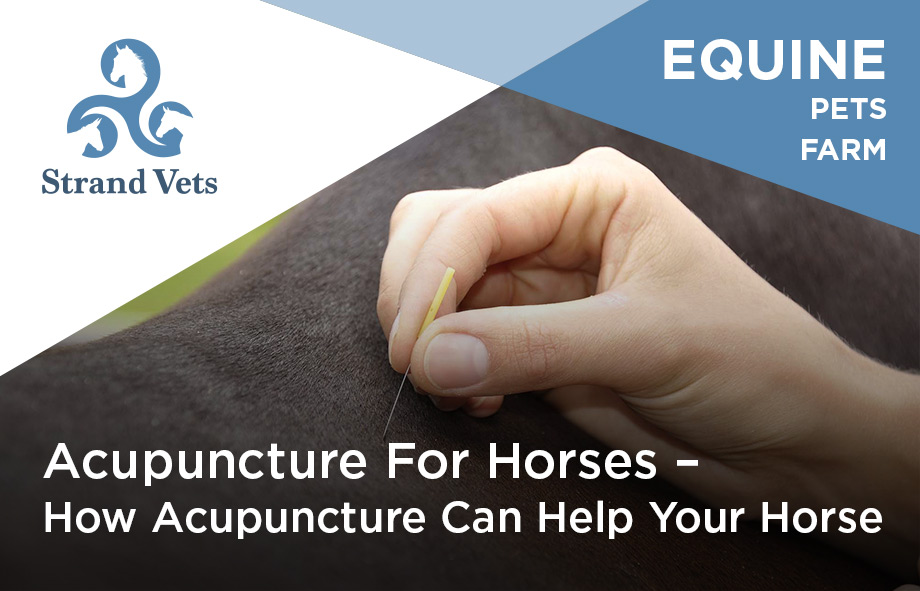
Find out how acupuncture could help your horse
01624 835424
Dedicated Call Answering
It can be frustrating to be left waiting at the end of a ringing telephone, so to eliminate this inconvenience, we have a dedicated call answering team to take calls should a vet be unavailable.
The Strand Vets team are trained to respond to emergency phone calls, book appointments and assist with general queries and will arrange for a vet to call you back as soon as is possible.
In emergency cases, they will prioritise your call and get a member of the practice to call you straight away.
Mobile Diagnostic Imaging
Our vets have access to a full range of modern portable diagnostic equipment including state-of-art x-ray generators and digital radiography equipment and ultrasound machines.
Ultrasonography
Ultrasonography utilises high frequency sound waves to image internal body structures in real time. We have 2 powerful ultrasound machines which allow high quality linear and sector images to be obtained directly at your yard.
Diagnostic ultrasound scans can be performed to look at the horse’s soft tissues including: tendons, ligaments and muscles for tears or strains; the abdomen for causes of colic and other abdominal disease; the chest for lung disease; and the reproductive tract for artificial insemination, reproductive problems and pregnancy diagnosis.
X-rays
Our powerful mobile equipment allows us to obtain high diagnostic quality of radiographs for most parts of the horse’s body, including the mouth, upper limbs, neck and vertebral column. As our digital system is a Direct-Reading machine, the images appear on the screen after only a few seconds. This system also enables detailed image manipulation, thereby increasing the diagnostic value over conventional film-based radiography.
Emergencies
Unexpected accidents or emergencies can occur at any time but you can be assured that the Strand Vets team provide round the clock emergency care and are available 24 hours a day, 7 days a week, 365 days a year for horses under our care.
During office hours (8:30am – 5pm, Monday to Friday) your call will be answered by one of our experienced reception staff. Out of office hours you will be redirected to the mobile phone of the vet on call who will be happy to give advice over the phone or visit your horse at your yard for emergency treatment as necessary (please note that for out of hours service different fees apply).
Get in touch in an emergency
01624 835424
Routine Health Checks
Wellness care can result in a healthier, longer life for the horse and a more predictable and manageable cost for the owner.
Horses can’t talk to you to tell you what’s wrong, but sometimes they communicate with subtle ways and without a trained eye or experience, you might miss some issues that are important to a horse’s well-being.
This includes:
- Assessment of your horse’s general bodily condition and opportunity to discuss your horse’s management and feeding
- A thorough hands-all-over examination checks for swellings, lumps, or bumps anywhere on the horse.
- Examination of your horse’s heart and lungs at rest
- Examination of the normal sounds of your horse’s G.I system
- Short soundness examination (walk/trot in hand)
- Examination of the teeth if required
- Examination of your horse’s eyes
- The chance to discuss any health concerns about your horse
- For an additional fee a blood sample may be taken for haematology, inflammatory profile and to check for liver and intestinal abnormalities
Book a routine health check
01624 835424
Worming
An appropriate worming programme is an important part of every horse owner’s basic horse care routine as these internal parasites can cause a wide range of problems from weight loss to colic and diarrhoea.
The lifecycle of most internal parasites involves eggs, larvae (immature worms) and adults (mature worms). Eggs or larvae are deposited onto the ground in the manure of an infected horse. They are swallowed while the horse is grazing, and the larvae mature into adults within the horse’s digestive tract (or sometimes in other tissues or organs). During this time, internal parasites can reduce a horse’s immunity and their nutrient utilisation, and in some cases cause permanent damage to internal organs. Young and elderly horses are most at risk of higher worm burdens, largely due to their under-developed or poor immunity.
Worms found in horses
Some of the internal parasites which are cause for concern include:
- Small strongyles (small redworms)
Encysted small redworm is particular worrying. The larval stage of the small redworm bury into the lining of the gut, where they lie dormant. They can then develop and emerge en masse from the gut wall in the early spring, causing diarrhoea and colic, with a mortality rate of up to 50%. - Large strongyles (large redworm)
- Tapeworms
- Roundworms
- Pinworm
In Strand Vets we have Tailored horse worming programmes to ensure specific worms are targeted with an effective product at the right time.
Healthy Horse Plan members get regular wormers included in their plan
01624 835424
To find out more about the Healthy Horse Plan and the range of benefits included, click below:Vaccinations
At Strand Vets we want to help you keep up to date with your vaccinations and will send you vaccination reminders so you don’t forget when your horse requires its vaccinations!
Regular vaccination of horses, ponies and donkeys is part of their primary care to prevent some serious, and potentially life-threatening, diseases.
These are some of the diseases against which horses are most commonly vaccinated in the UK:
Influenza
Influenza is a viral infection which most commonly affects young horses. The virus affects the respiratory system resulting in a high fever, runny nose and coughing. Though rarely fatal, it can be a very debilitating disease. Several disease outbreaks have occurred amongst unvaccinated animals in the UK over the last few years. Your horse should be given an initial primary course of 3 vaccinations. Following the first vaccination, the second needs to be given 21 to 92 days later. The third vaccination needs to be given 150 to 215 days after the second, and then booster vaccinations are given annually, within 365 days. The primary course may be started any time after your horse is five months old.
Tetanus
All horses and donkeys should be vaccinated against tetanus as it is usually a fatal condition in the horse. Tetanus is caused by the endotoxins produced by the bacteria, Clostridium tetanii. These spores can be found in soil and droppings just about everywhere and can survive in the environment for long periods of time. It enters the body through wounds, particularly puncture wounds if the wound is dirty. Deep puncture wounds are particularly dangerous as they provide an ideal site for infection as the bacteria thrive in anaerobic (low oxygen) environments. Puncture wounds on the sole of the foot are common sites of infection.
Equine Herpes Virus (EHV)
The equine herpes virus can be found in most horses all over the world. There are five types of Equine Herpesvirus, but EHV 1 and EHV 4 are the most clinically important, and they are the only types which can be vaccinated against. EHV-1: Can cause four manifestations of disease in horses, including neurological form, respiratory disease, abortion and neonatal death. EHV-4: Causes a nonfatal upper respiratory tract disease in foals and is uncommonly associated with abortion and rarely with neurological disease. To provide effective immunity against respiratory and neurological disease caused by EHV 1 and EHV- 4 a primary course of 2 vaccinations should be given, followed by a booster vaccination every six months.
1st vaccination: Can be given to any horse over the age of 5 months.
2nd vaccination: To be given 4-6 weeks after the 1st vaccination.
6 month booster: To be given within 6 calendar months of the 2nd vaccination.
To provide effective immunity against abortion caused by EHV 1 and EHV-4, a course of three vaccinations should be given to a mare during her 5th, 7th and 9th months of pregnancy.
Competition Horses
Competition horse owners should ensure that their horse (or pony) is vaccinated in accordance with the rules of the appropriate sporting governing bodies under which they are competing (e.g. FEI, British Showjumping, British Eventing, British Dressage, British Riding Clubs, etc). Vaccination rules may differ amongst these organisations and passports may be requested at any time during events. Our vets will be happy to offer you advice and check your horse’s vaccination record prior to a competition, however, be aware that it is your responsibility to ensure that your horse or pony’s vaccination record is correct and up to date and that any lapse in the vaccination record, even by a few days, may be considered by a sport’s governing body to be a breach of its rules.
Healthy Horse Plan members get annual boosters included in their plan
01624 835424
To find out more about the Healthy Horse Plan and the range of benefits included, click below:Digital DR
Why take your pets or horses off the island for a digital x-ray?
While the majority of vets will have some form of x-ray equipment, not all systems are the same.
Modern digital systems are what hospitals use on us when we’re ill, and allow the image to be viewed immediately on a computer screen.
Quick, high-quality x-rays allow for a swift diagnosis, and also allows for rapid adjustments to be made. When this isn’t possible it means animals need to be kept under sedation or restraint for longer, exacerbating their discomfort and the potential side-effects of taking such measures.
This is even more useful when we are treating our equine patients on the road, where the slightest movement from a horse could distort the image, and allows us to try again with minimum fuss.
While we make use of this more advanced technology, many practices on the island still use the old system, and some owners take their animals off the island to access accurate diagnoses.
We’re committed to providing the highest level of veterinary care with the best equipment – and to making sure everyone on the island has access to the facilities they need to keep their pets and horses healthy.